The Ships
From 1744 to 1815, 55 ships were built on contract for the Royal Navy including 3 that fought at the Battle of Trafalgar, HMS Euryalas, HMS Agamemnon and HMS Swiftsure. The largest was a 74 gun, HMS Spencer, 180ft on the upper deck which was launched in 1800.
HMS Agamemnon, 64 guns
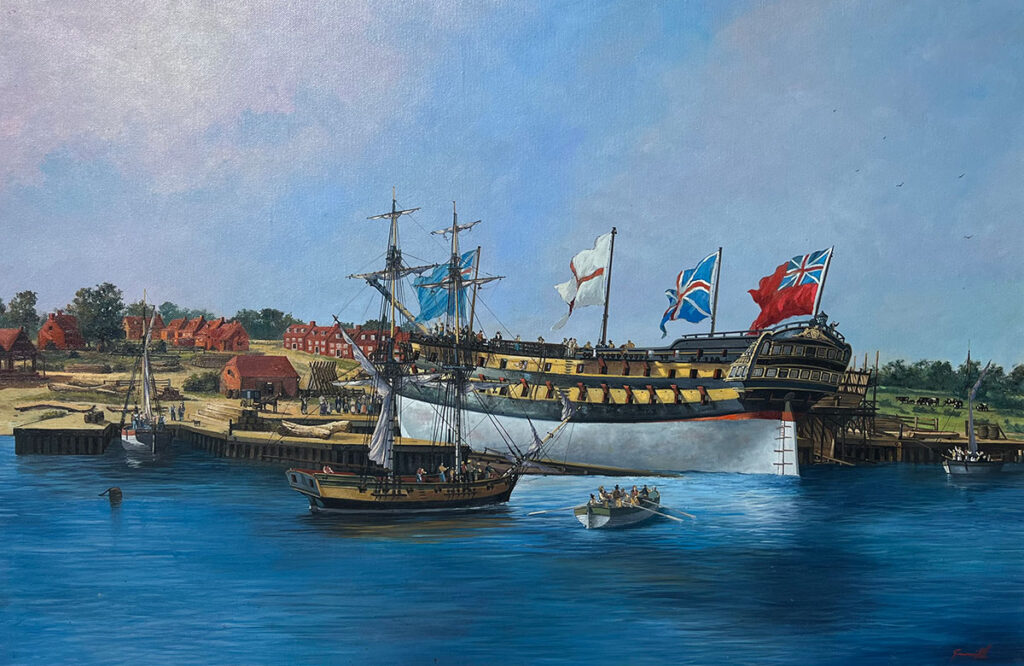
Agamemnon was a 64-gun, Ardent-class third-rate built at Bucklers Hard and launched in 1781. Nelson’s favourite (he captained her 1793–96), she fought through the American Revolutionary, French Revolutionary and Napoleonic Wars, seeing action at the Saintes (1782), Genoa and the Hyères Islands (1795), Copenhagen (1801), Cape Finisterre (1805), Trafalgar (1805), San Domingo (1806) and the second Copenhagen (1807). She was also touched by the 1797 Spithead/Nore mutinies and suffered frequent groundings and repairs; at Trafalgar she sailed in the weather column and helped force the surrender of Santísima Trinidad.
Worn out by 1809, Agamemnon was wrecked on an uncharted shoal in Maldonado Bay, River Plate, on 16 June; all hands were saved and her captain was acquitted. The wreck was found in 1993, and her legacy endures in art and literature, a commemorative woodland near her place of construction, and the reuse of her name for a modern Royal Navy submarine.
- Read more under Projects
HMS Scorpion, 14 guns
Launched in 1746, Scorpion was the second naval vessel built at Buckler’s Hard. She was constructed by James Wyatt, a timber merchant capitalist, and his partner, John Major, a shipwright, with Henry Adams present as Navy Board Overseer. In 1759, Scorpion took part in General James Wolfe’s famous expedition to Quebec. She carried soldiers up the St Lawrence River for the attack and was one of the ships to bombard the French position. Wolfe, like Nelson, died in his moment of victory, and New France fell to the British to become Canada. Three years later, Scorpion foundered in the Irish Sea.
HMS Heroine, 32 guns
Launched in 1783, Heroine represented a calculated risk to Henry Adams, as she was built on speculation, not in response to a firm order from the Navy. Adams already had a contract to build the 64-gun Indefatigable, but his second launchway was empty and his workforce was underemployed, so he used his own capital for the venture, as well as many of the timbers that were too small for the larger ship. The gamble paid off and the Navy purchased Heroine on completion for £10,274. In 1795 and 1796, Heroine was part of the British squadron that forced surrender of Trincomalee and Colombo in Ceylon from the Dutch, and, following her conversion to a troopship in 1800, she landed an Anglo-Turkish force at Aboukir Bay at the mouth of the Nile in March 1801.
HMS Thames, 32 guns
Henry Adams launched Thames at Buckler’s Hard on 10th April 1758. Unusually, she was built largely of imported oak and Adams himself had to provide masts, yards, furniture and stores. This was probably because the strains of war against France were beginning to tell on the Royal dockyards. Thames enjoyed a long career, seeing service in the Seven Years’ War, the War of American Independence and the Revolutionary Wars against France, until, in 1793, she was captured by the French en route to Gibraltar. She then served in the French Navy as the Tamise.
HMS Indefatigable, 64 guns, reduced to 44 guns 1795
Indefatigable was launched in 1784 at the beginning of ten years’ peace following the American War of Independence. In 1796, she was in Plymouth harbour alongside the troop ship, Dutton, which started to run aground in heavy seas. The officers aboard panicked and the troops resorted to liquor, but Indefatigable’s commander Edward Pellew swam out to her, took control, and all the men were saved, an action for which he was created a Viscount. In 1797 Indefatigable took part in a spectacular action in the aftermath of the failed French invasion of Ireland in support of Wolf Tone’s rebellion – an action in which the French ship, Droits D’Homme (below) was captured.
HMS Santa Margarita, 36 guns
Not all Henry Adams’ contracts were for the building of new ships. Between 1791 and 1793, for example, he rebuilt the Santa Margarita, a Spanish ship which had been captured off Lisbon, Portugal in 1779. Unlike Thames, she kept her name, and in 1796 found herself involved in a fierce action off Waterford, Ireland, with Tamise. A Spanish ship rebuilt at Buckler’s Hard flying British colours was thus victorious against a British ship built at Buckler’s Hard flying French colours!
HMS Illustrious, 74 guns
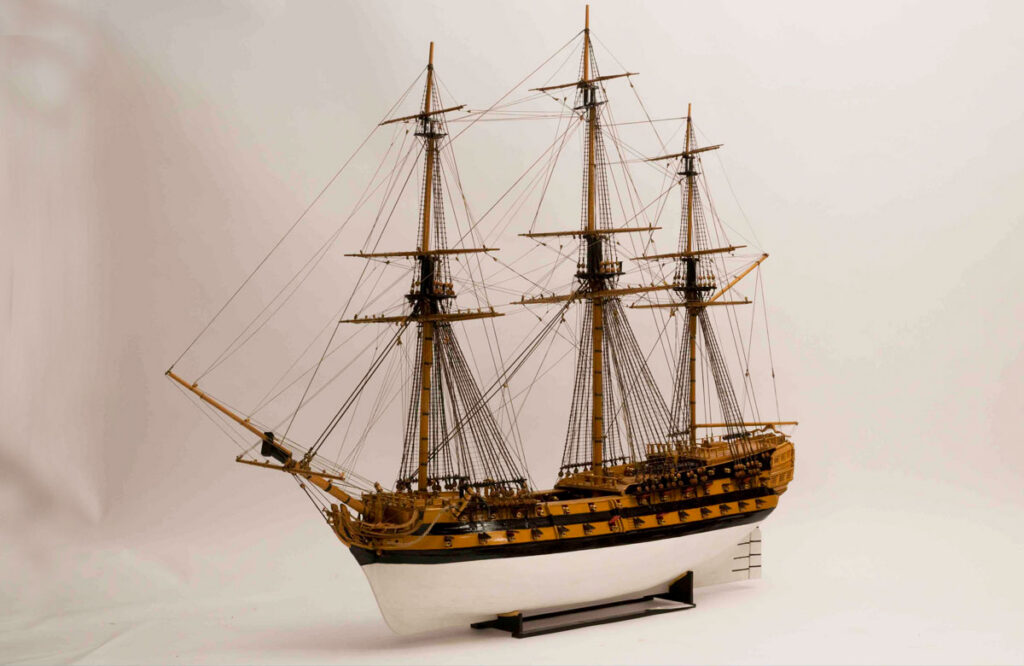
The first ‘74’ built at Buckler’s Hard, Illustrious was launched on 7th July 1789. Henry Adams had delayed the launch in the hope that King George III and Queen Charlotte, who were staying in nearby Lyndhurst, would attend. In the event, they only got as far as Beaulieu but, undaunted, Adams fitted a cannon on board Illustrious and fired a 21-gun salute in their honour.
Illustrious served in the Mediterranean under Vice-Admiral Hotham during the war against the French. But she had an unlucky career; in 1794 she was dismasted in an action and in March 1795 she was wrecked off the Italian coast when caught in a gale 50 miles east of Genoa. Fortunately no lives were lost and her crew, under Captain Thomas Frederick, was able to remove all the stores and supplies to other ships, including 60 guns and 269 barrels of powder. She was then set on fire.
HMS Spencer, 74 guns
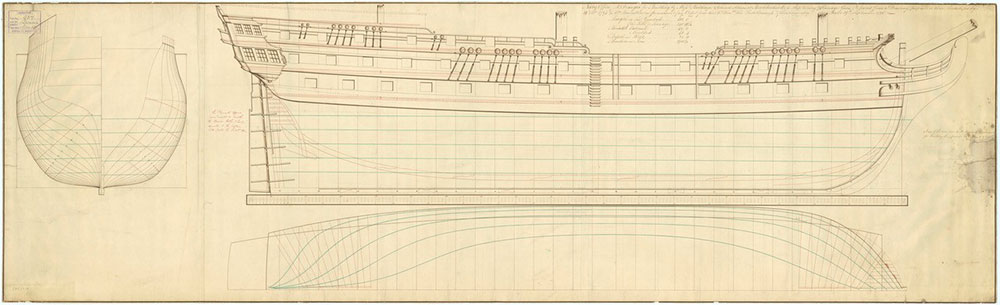
Spencer was launched on 10th May 1800, when Sir Christopher Saxton stepped in for Earl Spencer, who was unable to be present. Five years later, it was Spencer herself who was missing – from the Battle of Trafalgar. Nelson kept his fleet supplied by sending them to Gibraltar in detachments. Spencer’s turn to take on water and stores coincided with the battle and so she missed her place in history. She later took part in several smaller expeditions and actions before being broken up in 1822.
HMS Euryalas, 36 guns
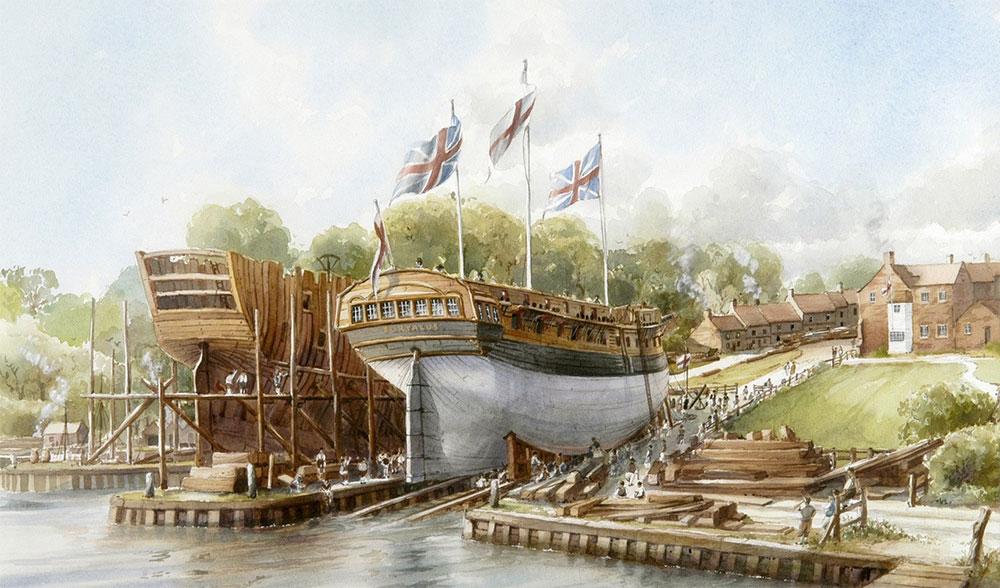
Nicknamed ‘Nelson’s Watchdog’ because she reported the movements of the Franco-Spanish Fleet in Cadiz Harbour shortly before Trafalgar, the frigate Euryalus was launched at Buckler’s Hard on 6th June 1803. During the Trafalgar campaign she was captained by the Hon Henry Blackwood, who, shortly before the battle, suggested that Nelson should transfer to her from the Victory as she was less conspicuous; Nelson refused.
Although she took no part in the fighting, Euryalus did have a prominent part in the battle and its aftermath. Vice-Admiral Pierre Villeneuve, commander of the Combined Fleet, was given quarters on board after his own ship, Bucentaure, sank. Euryalus also took in tow the dismasted Royal Sovereign, whose commander, Vice-Admiral Cuthbert Collingwood, transferred his flag to her. It was while on board that he wrote the dispatch containing the news of the ‘complete and glorious victory’ at Trafalgar and described Nelson’s death as ‘the loss of a Hero, whose name will be immortal, and his memory ever dear to his country’.
Trafalgar was the beginning of a long career for Euryalus. She saw service in the Baltic, Mediterranean, West Indies and North America, where she sailed up the Potomac River and took part in the destruction of Fort Washington.
HMS Swiftsure, 74 guns
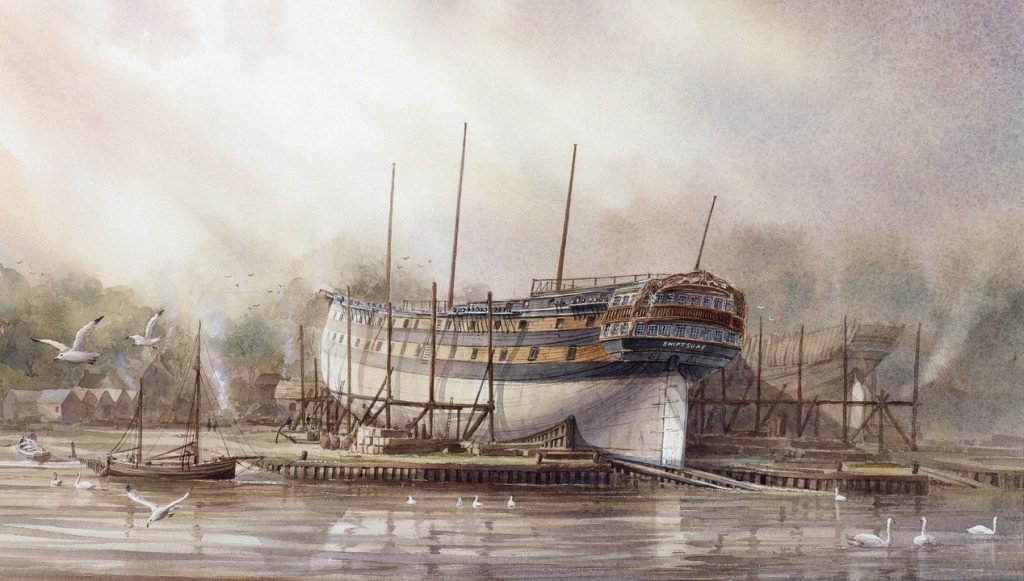
The launch of Swiftsure on 24th July 1804 was witnessed by over 3,000 spectators, accounting for the arrival of no less than 135 carriages in the tiny village. The Adams brothers entertained 110 special guests at a celebration dinner in a wooden banqueting hall built at the side of the Master Builder’s House, while Charles Hemans, landlord of the Ship Inn, served five hogsheads (2,100 pints) of beer to the rest. Swiftsure fought in the lee column at Trafalgar under the command of Captain William Rutherford, sinking the French ship Achille. Confusingly, both the British and French Fleets had ships called Swiftsure and Achille, a result of captured ships being used by their new owners. After the battle, Swiftsure was towing the prize, Redoubtable, the French ship from which a sniper had shot Nelson, when a violent gale blew up, threatening to sink the latter. The crew, at great risk to themselves, managed to save 170 of their French counterparts.


Follow us on social media for our latest news.